> ## Documentation Index
> Fetch the complete documentation index at: https://docs.repacket.com/llms.txt
> Use this file to discover all available pages before exploring further.
# Entities
> Targets for applying security and policy features within Repacket
Entities are the traffic targets for configuration in Repacket. They let you define what properties we should match against to enforce your rules, including custom categories and IP ranges.
## Creating Entities
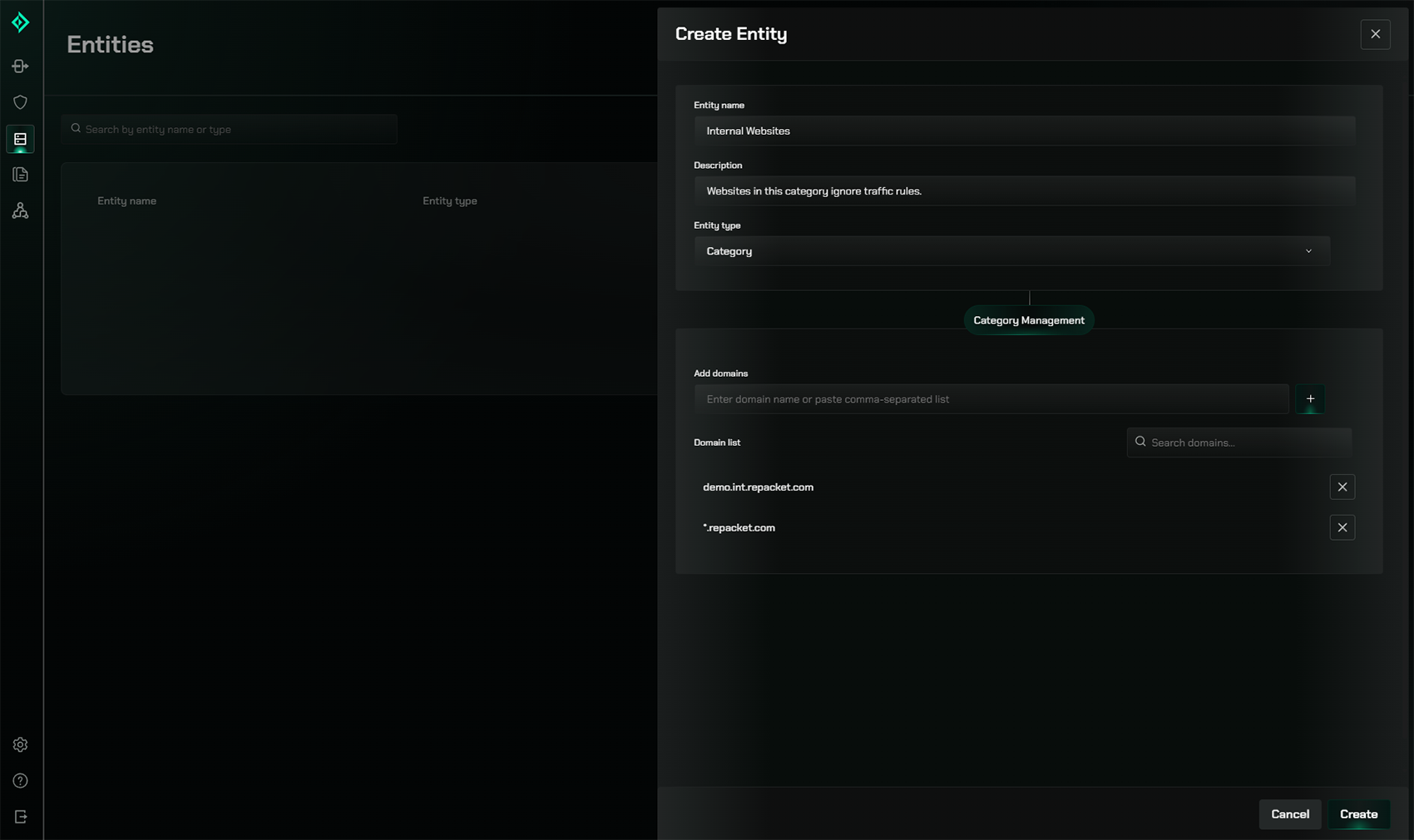
To create a new entity, navigate to the [Entities page](https://app.repacket.com/entities#entities) in your Repacket dashboard and click the "Create" button.
 ## Entity types
Today, Repacket allows you to configure custom categories and IP ranges.
### Categories
Categories represent a group of domains. These can include wildcards, *and often should*.
Repacket ships with nearly [80 default categories](/config/categories).
## Entity types
Today, Repacket allows you to configure custom categories and IP ranges.
### Categories
Categories represent a group of domains. These can include wildcards, *and often should*.
Repacket ships with nearly [80 default categories](/config/categories).
 ### IP Ranges
IP ranges allow you to target traffic based on the destination IP address.
These use CIDR notation and are generally used to exclude your internal websites from Repacket features.
### IP Ranges
IP ranges allow you to target traffic based on the destination IP address.
These use CIDR notation and are generally used to exclude your internal websites from Repacket features.